
Learn by theme
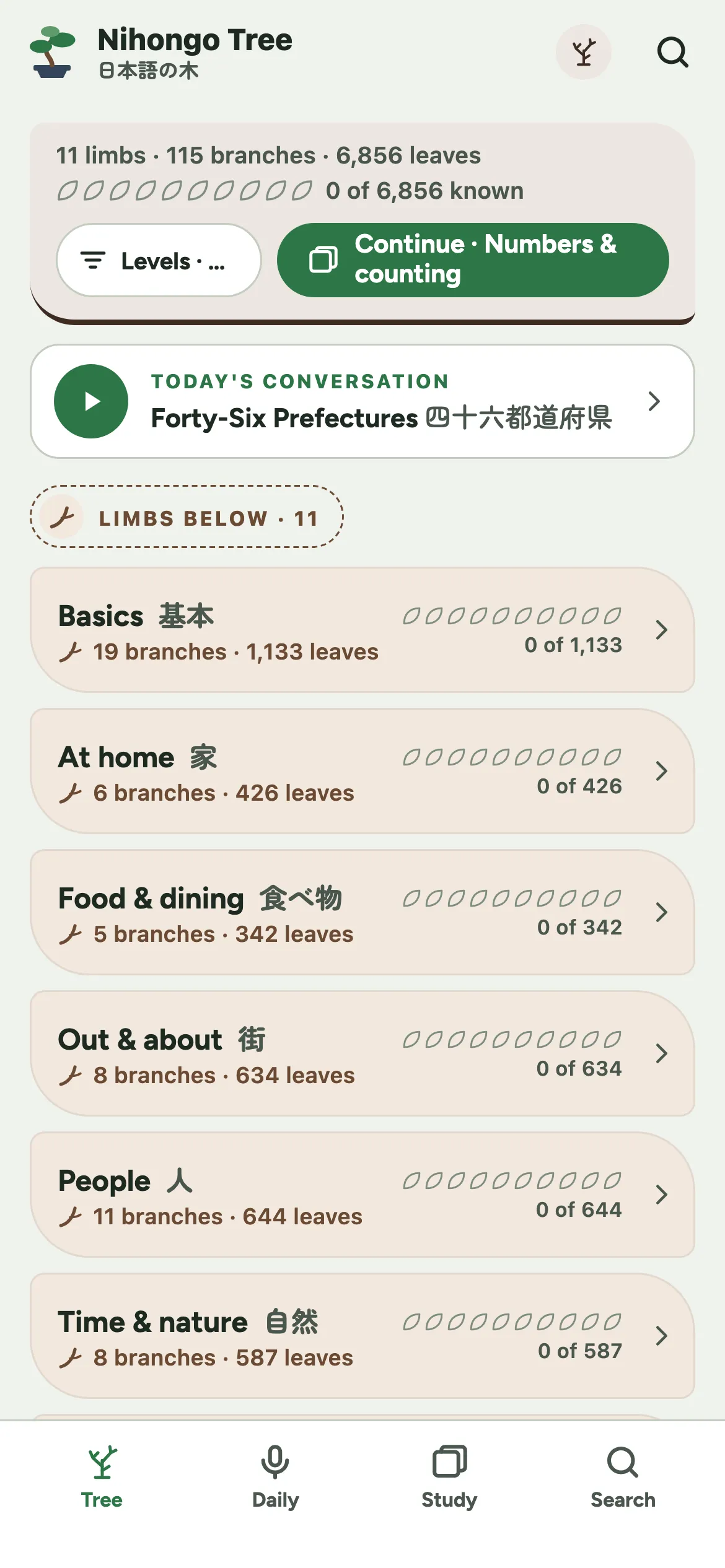
11 areas and 115 themes, from the kitchen and the izakaya to the clinic and the office. Related words live together, the way you actually meet them.


Japanese vocabulary, branch by branch.
Runs in any modern browser, on desktop or phone · Free, no sign-up
Most Japanese resources stop at the beginner stage. Once you can read kana and order a coffee, the help thins out: apps and textbooks keep circling the same first few hundred words, and the dictionaries that go further are built for looking words up, not for learning them.
When I was in Japan, what worked for me was a paper vocabulary book organised by theme. I could not find anything like it online for intermediate learners: a Japanese–English word list you study by topic, not one search at a time. So I built one. Nihongo Tree groups about 6,800 everyday words into 115 themes across 11 areas of daily life.
The vocabulary is shaped like a bonsai: 11 limbs for areas of daily life, 115 branches for themes, twigs for word groups and a leaf for every word. Leaves turn green as you learn them, so you can see which parts of daily life you can already talk about.
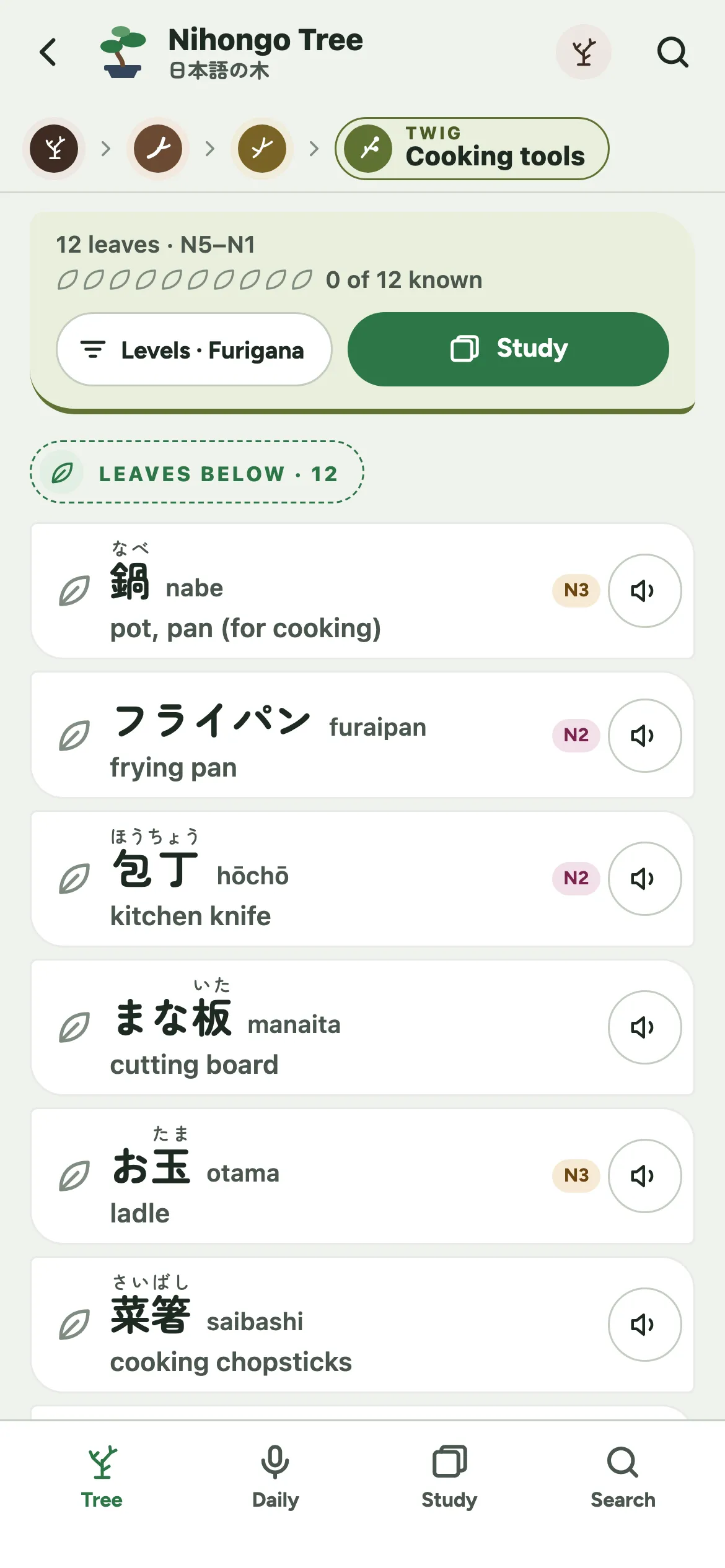
Every word has furigana, romaji, an English meaning, a JLPT level and an example sentence. There has been no official JLPT word list since 2010, so levels follow Jonathan Waller’s community lists; you can still study a JLPT N3 vocabulary list theme by theme. The groupings, meanings and example sentences were written with AI assistance and curated by me, and the audio is text-to-speech rather than recorded voices.
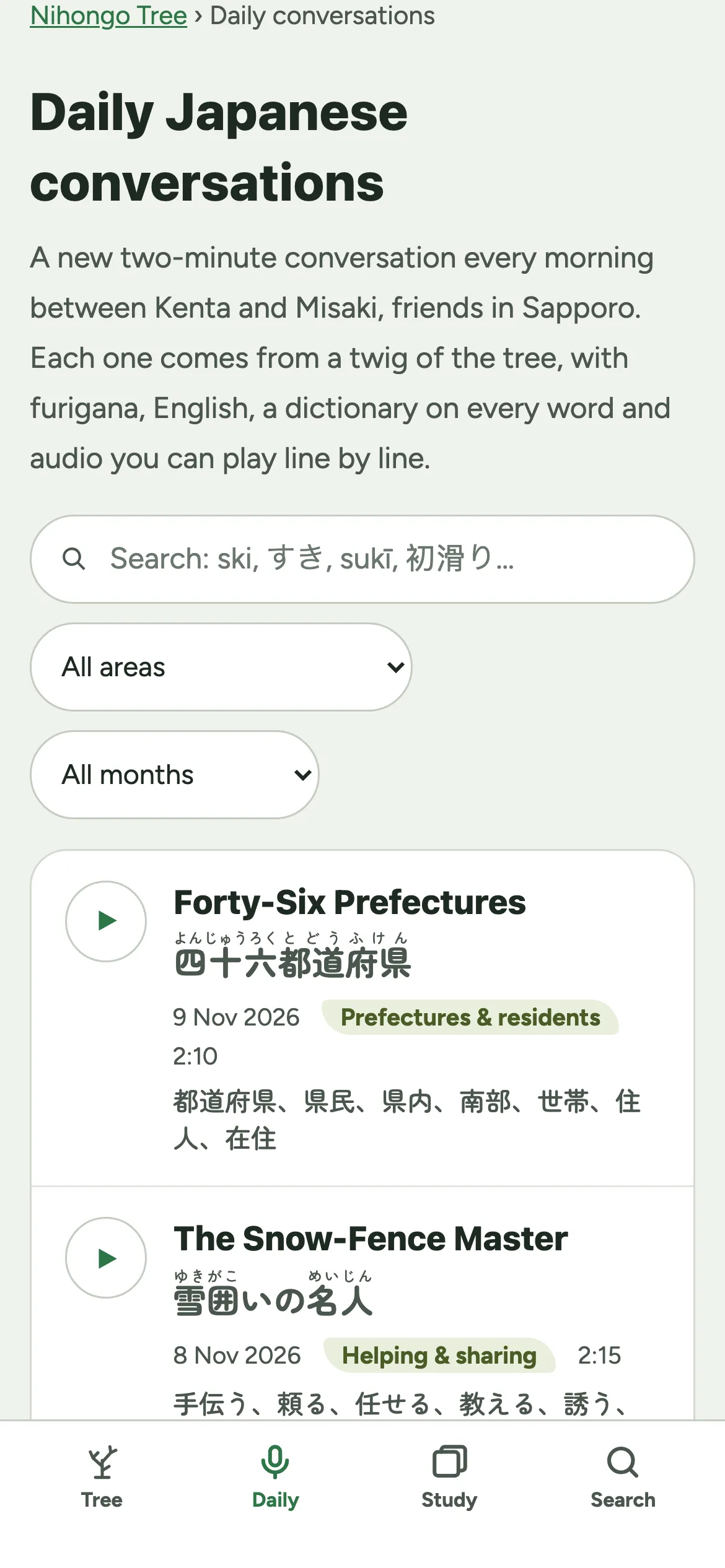
Something new grows every morning, too: a two-minute episode of daily Japanese conversation practice between Kenta and Misaki, two old friends from Sapporo, built around one word group from the tree, with the script, furigana, English and a study sheet. If you’ve hit the intermediate plateau, start with this guide to intermediate Japanese. All of it is free, with no account and nothing to install. Start with Japanese vocabulary by theme.
Made for the phone in your pocket: pick an area of daily life, open a word group and study the leaves, then hear today’s two-minute conversation.
The whole tree
A word group
Daily conversations
11 areas and 115 themes, from the kitchen and the izakaya to the clinic and the office. Related words live together, the way you actually meet them.
Readings over every kanji, switched on or off in one tap. Romaji and English toggle too, so you can lean on them early and drop them later.
Every word and every example sentence has text-to-speech audio, so you learn how it sounds, not just how it looks.
Study any word group as flash cards on a spaced review schedule, drill verb conjugations, or download free Anki decks for JLPT N5–N1.
Each word carries its JLPT level from N5 to N1. Filter to focus on exactly what your exam needs.
Mark words as known and the leaves turn green at every level, from a single theme up to the whole tree.
Yes, completely. There is no account, no subscription and nothing to install.
It is built for intermediate learners, the stage most resources skip, though beginners can use it too. Every word carries its JLPT level (N5 to N1), so you can filter to the words you need.
No. All word, sentence and daily conversation audio is generated with text-to-speech. It is clear and consistent, but it is a synthetic voice, not a recording.
Yes. Nihongo Tree offers free Anki decks for each JLPT level from N5 to N1, plus one for the 1,000 most common words.
The JLPT has not published an official vocabulary list since 2010, so levels follow Jonathan Waller’s widely used community lists (tanos.co.uk). Treat them as a guide.
Knowing hiragana and katakana helps. Kanji always has furigana available, and romaji can be switched on while you are starting out.
In your own browser, on your device. Nothing is sent to a server, so progress does not sync between devices.
Yes. It works in any modern mobile browser.
Support
One person builds these apps and reads every email. Hit a bug or want a feature in Nihongo Tree? Tell me.
Or just email support@anthem-technology.com.